11 models, 6,300 to 63,000 kN. Select a model to open its source table.
THE ARCHITECTURE
Build the process around hot die forging.
Hot, warm and cold forging require different motion and tooling conditions.
Use the source-specific technical tables below to check the model and configuration. The part, tooling envelope and transfer requirements are reviewed together before an equipment recommendation.
Bring the process into focus.
01Workpiece material and thickness
02Part geometry and tooling envelope
03Required operations and production target
04Feeding, transfer and automation interfaces
ENGINEERING EVIDENCE
Design decisions that carry the load.
Documented in the series source materials.
01
High-energy flywheel drive
Large flywheel inertia delivers high output energy suited to hot forging and extrusion of a wide range of parts. The HGP variant adds a two-stage transmission with an extra gear set, raising output energy above the HFP version. Slide stroke rates reach 50–100 spm, keeping die-to-workpiece contact time short.
50–100 spm; HGP two-stage transmission02
Pre-tightened combined frame
The combined frame is hydraulically pre-tightened with high-strength tie rods for easy disassembly and transport. Columns and crown are stress-relieved steel weldments over a cast steel bed, and a widened table increases process adaptability.
Tie-rod hydraulic pre-tensioning03
Off-center load capacity
A wide-body two-point integral connecting rod and extended slide guides provide strong resistance to eccentric loads, allowing multi-station die layouts. The X-type guide design compensates for guide clearance changes caused by temperature rise.
Two-point connecting rod; X-type guides04
Multi-station automation ready
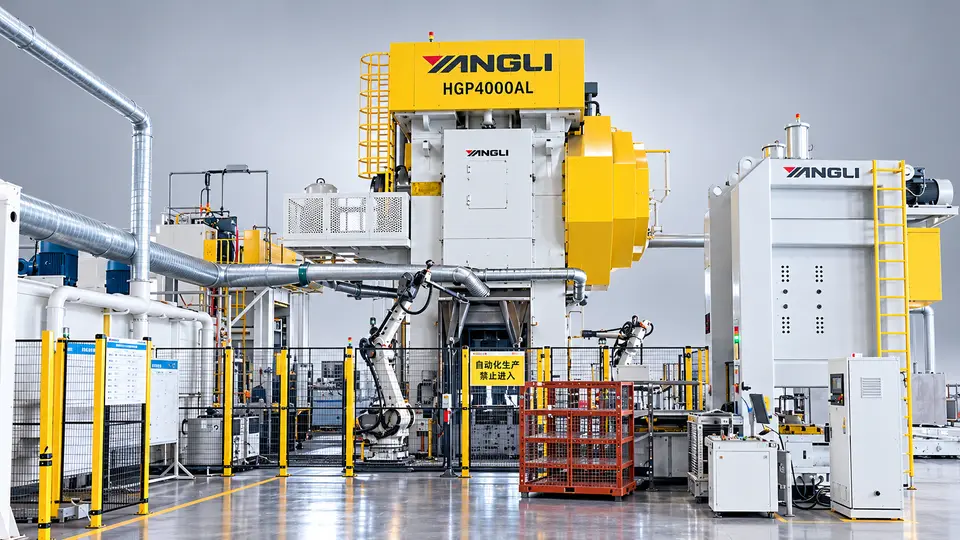
A side window in the frame enables transverse feeding and, combined with a stepping manipulator, supports multi-station automatic forging. The series covers nominal forces from 6,300 to 63,000 kN (HFP-630S to HGP-6300S).
Side window transverse feeding; 6,300–63,000 kN
HFP/HGP hot die forging press; the frame side window allows transverse feeding for multi-station automatic forging lines.
SOURCE TABLES
The details that decide.
Pick a source edition, then a model. Tables from different documents are never combined. Request the original when cells are not yet aligned.
Source
Models in this table
Select a model. Drag it onto the Compare tray to pin it; drag a pinned model again to unpin.
HFP-630S
p. 75 March 2026 general catalog, p. 75
Nominal force6300kN
Slide stroke220mm
Die height adjustment10mm
F·B970mm
F·B750mm
Upper ejector device30kN
Stroke25mm
Lower ejector device2-50kN
Stroke30mm
Catalog reference. Confirm the ordered configuration with YANGLI.