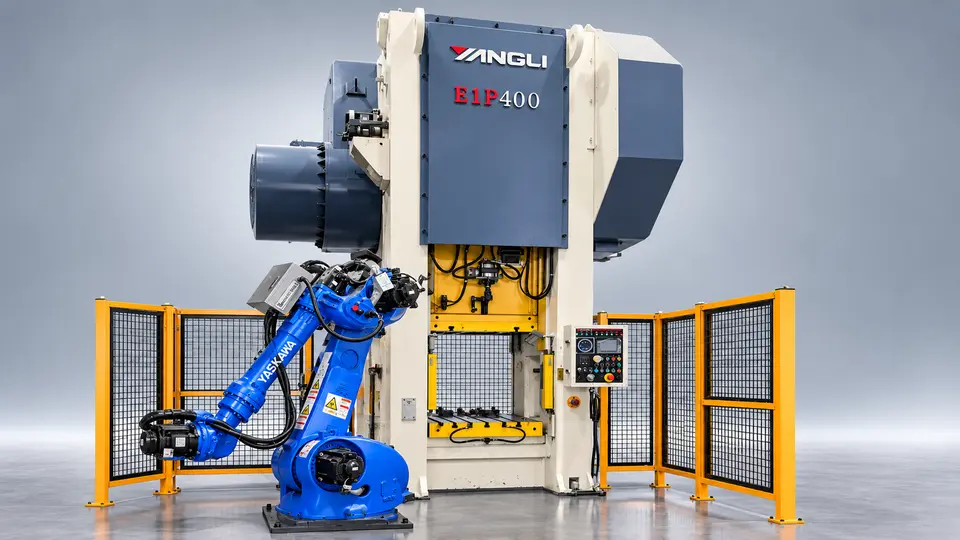
12 models, 1,600 to 10,000 kN. Select a model to open its source table.
THE ARCHITECTURE
A dedicated platform for hot die forging.
Hot, warm and cold forging require different motion and tooling conditions.
Use the source-specific technical tables below to check the model and configuration. The part, tooling envelope and transfer requirements are reviewed together before an equipment recommendation.
Bring the process into focus.
01Workpiece material and thickness
02Part geometry and tooling envelope
03Required operations and production target
04Feeding, transfer and automation interfaces
ENGINEERING EVIDENCE
Design decisions that carry the load.
Documented in the series source materials.
01
Economical hot die forging range
The E1P series covers nominal forces from 1,600 to 10,000 kN across six sizes (E1P-160 to E1P-1000). Maximum stroke rates range from 50–55 spm on the smallest model to 30–35 spm on the largest, with inverter-based speed regulation.
1,600–10,000 kN; 30–55 spm with inverter02
Rigid welded frame and slide
The frame is an integral steel weldment, stress-relieved after welding and machining, then tempered and shot-blasted. A special eccentric shaft with short pivot distance and eight-face slide guides give high guiding accuracy and eccentric load resistance for multi-station forging.
Eight-face guides; short-pivot eccentric shaft03
Hydraulic overload protection
An imported hydraulic overload protector inside the slide unloads immediately when the press is overloaded, stopping the slide and sending an electrical signal to protect both machine and dies.
Imported hydraulic overload protector04
Dry clutch and optional three-stage drive
A separated dry-type pneumatic friction clutch and brake transmits high torque and is easy to install and maintain. E1P-xxxS variants add a customized three-stage drive for specific process requirements.