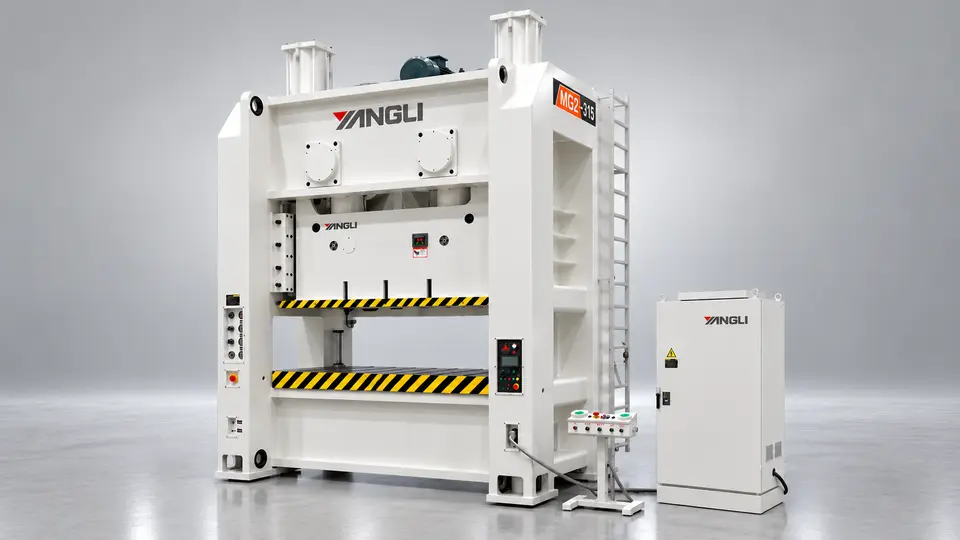
MG2 series gantry type two point presses, 9 models with nominal force from 1100 to 8000 kN (110 to 800 tons).
THE ARCHITECTURE
A two-point platform for wider tooling.
Compare single- and two-point drives in gantry frames.
Use the source-specific technical tables below to check the model and configuration. The part, tooling envelope and transfer requirements are reviewed together before an equipment recommendation.
Bring the process into focus.
01Workpiece material and thickness
02Part geometry and tooling envelope
03Required operations and production target
04Feeding, transfer and automation interfaces
ENGINEERING EVIDENCE
Design decisions that carry the load.
Documented in the series source materials.
01
Two-point drive with reverse-rotating crankshafts
The MG2 is a gantry type two point press: double crankshafts rotate in reverse to mutually cancel lateral forces. Combined with the highly rigid H-type frame, this reduces frame deflection for higher precision metal stamping.
Two-point / dual crankshaft02
Fast-response hydraulic overload protection
The hydraulic overload system relieves the pressure of a tonnage overload in milliseconds, stopping the press immediately. Hydraulic pressure is restored with the press of a button, and normal operation is inched back to top dead center, protecting press and dies.
H.O.L.R. / die protection03
Extra-long gib guiding
Eight-point, extra-long gib surfaces on the slide are always maintained within the guides and provide off-center guiding. Bronze gib liners work with a recirculating oil lubrication system.
8-point gibs / bronze liner04
Combined dry clutch/brake unit
The MG2 is equipped with a high-torque combined clutch/brake unit with pneumatic control and dry friction material in cast iron construction, with transmissible torques from 7,400 Nm to 40,925 Nm. Clamping to the shaft is carried out only with keyways.
Clutch/brake, 7,400–40,925 Nm
5
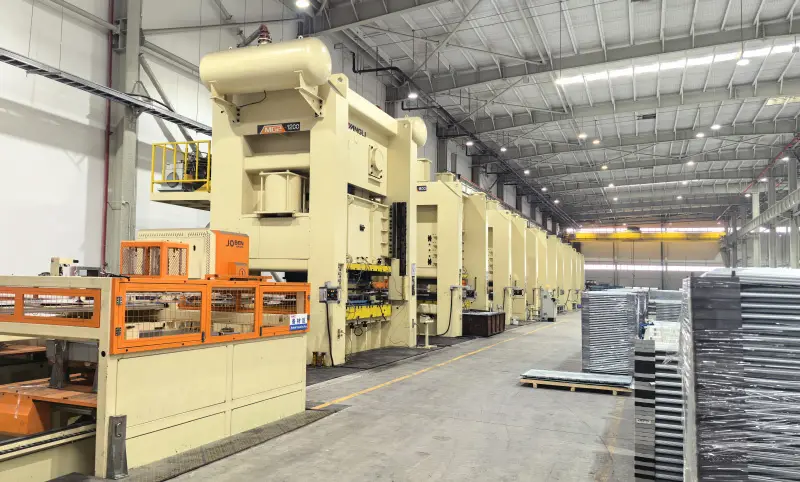
Compact design: the space required for 4 traditional presses is enough for 5 MG2 series presses.
MG2 series gantry type two point high-accuracy, high-performance press.
EQUIPMENT MANIFEST
What ships standard. What can be added.
Standard
OMPI dry clutch and brake
Flywheel brake
Hydraulic overload system
Air counterbalance system
Automatic lubrication system
Motorized slide adjustment
Digital die height indicator
Knockout bar
Removable, flanged, T-slotted slide plate and bolster
Press control with Mitsubishi/Omron PLC controller
Optional
Press controls from Wintriss, Link, Rockwell Automation (Allen-Bradley), Siemens or Mitsubishi
Anti-vibration press leveling mounts
Safety light curtains
Tonnage monitor
Quick die change system
Die cushion (dual air cushion)
Compact servo feed line
Variable SPM (inverter speed control)
SOURCE TABLES
The details that decide.
Pick a source edition, then a model. Tables from different documents are never combined. Request the original when cells are not yet aligned.
Source
Models in this table
Select a model. Drag it onto the Compare tray to pin it; drag a pinned model again to unpin.
MG2-110 / I
p. 41 March 2026 general catalog, p. 41
Nominal force1100kN
Nominal stroke5mm
Slide stroke180mm
Fixed50
SPM — variable (optional)30-60min⁻¹
Max die height400mm
Die height adjustment90mm
Bolster area(F·B×L·R)680×1650mm
Bolster thickness130mm
Slide area(F·B×L·R)580×1360mm
Shank hole(Dia×Depth)3-Φ60×70mm
Between columns1750mm
Side opening650×400mm
Main motor power11kW
Air cushion(option) Eject force×Stroke×Qty.40×70×2kN×mm
2026-10-26 customer-confirmed values. Cells marked ✓ use the MG2 manual where it differed from the catalog.