Tie-rod pre-tightened frame
Big and main parts are optimized by finite element analysis. The steel welded frame is pre-tightened with tie-rod bolts for high strength and rigidity.
FEM-optimized, tie-rod pre-tightened
A single-point drive within a straight-side frame.
Open the source tables ↓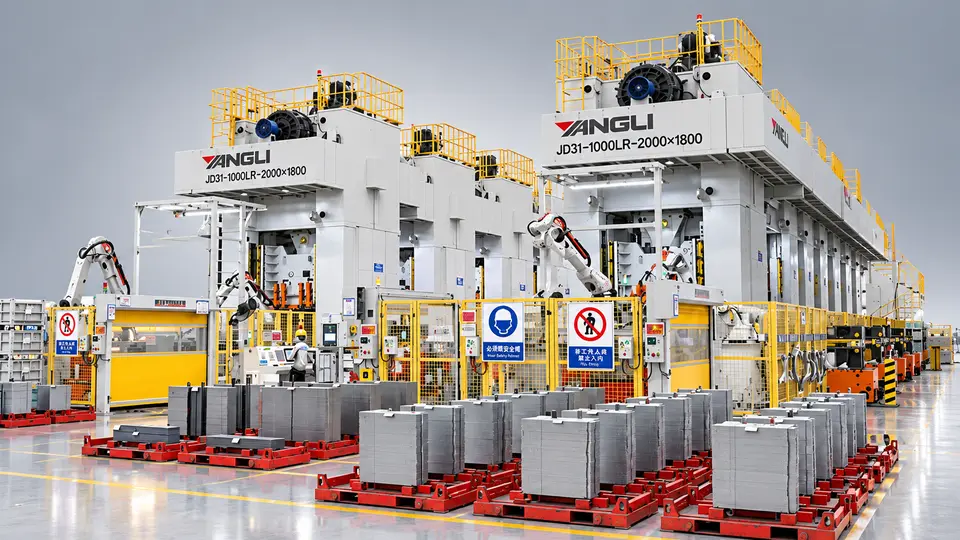
7 models, 5,000 to 20,000 kN. Select a model to open its source table.
A single-point drive within a straight-side frame.
Two- and four-point platforms, blanking and transfer architectures.
Use the source-specific technical tables below to check the model and configuration. The part, tooling envelope and transfer requirements are reviewed together before an equipment recommendation.
01Workpiece material and thickness
02Part geometry and tooling envelope
03Required operations and production target
04Feeding, transfer and automation interfaces
Documented in the series source materials.
Big and main parts are optimized by finite element analysis. The steel welded frame is pre-tightened with tie-rod bolts for high strength and rigidity.
FEM-optimized, tie-rod pre-tightenedThe single-point press uses a guide post and bushing structure with a pneumatic friction clutch and brake. Main lubrication is an electric oil system.
Guide post and bushingControl is by electronic cam and mechanical cam in a double circuit, with an imported safety dual solenoid valve. The press covers 5,000–8,000 kN nominal force.
Electronic and mechanical cam controlOptional equipment includes air cushion, moving bolster, tonnage gauge and anti-vibration pads. A rigid slide knockout with 150–200 mm stroke is also available.
5,000–8,000 kN rangePick a source edition, then a model. Tables from different documents are never combined. Request the original when cells are not yet aligned.
Source
Models in this table
Select a model. Drag it onto the Compare tray to pin it; drag a pinned model again to unpin.
Catalog reference. Confirm the ordered configuration with YANGLI.
Share your drawing, material and production requirements. Start with a selected model or explore the equipment direction together.
Discuss your project ↗